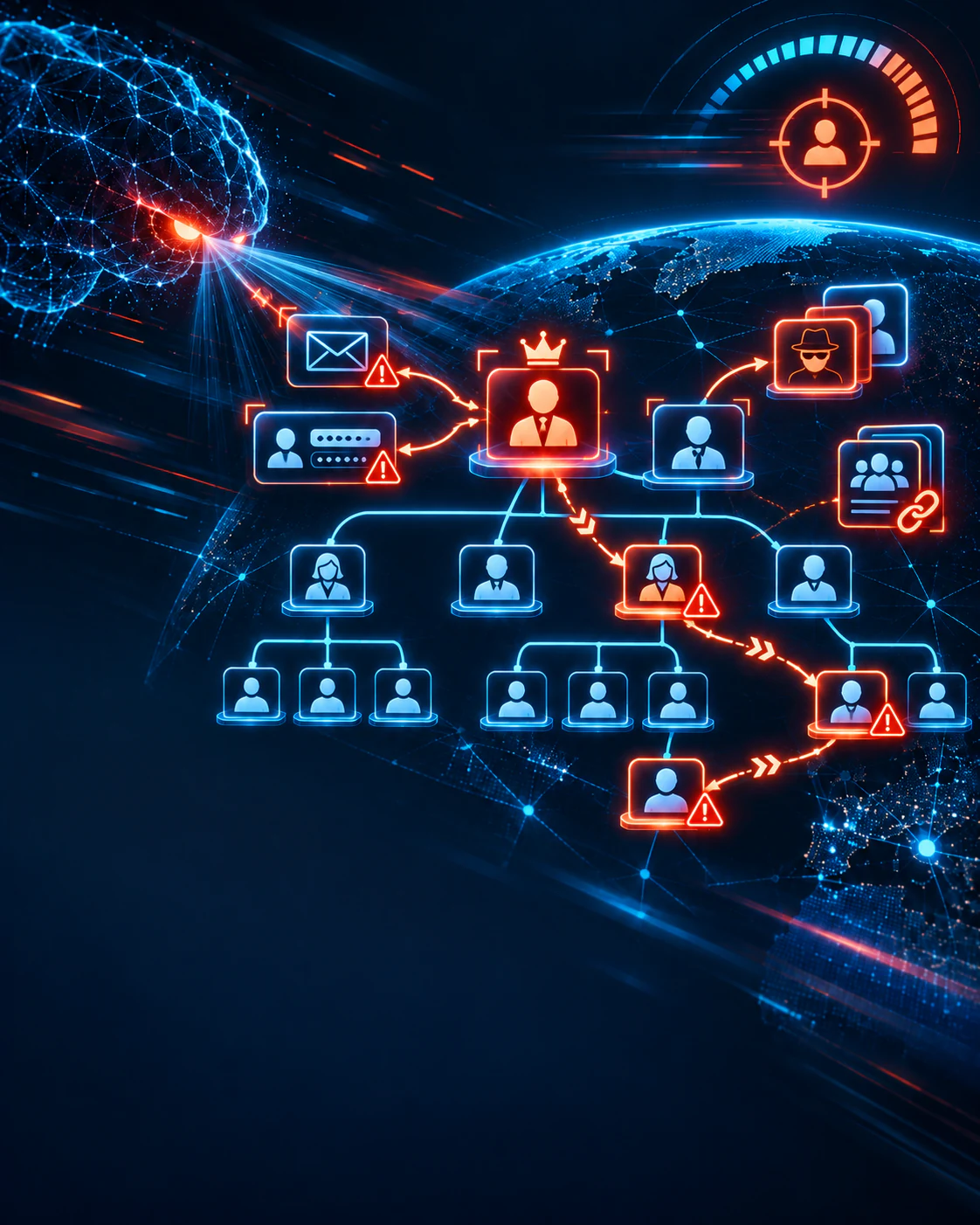
An organizational directory can tell an attacker who holds authority, who works together and which relationships are likely to be trusted. Combined with stolen email, credentials or cloud account data, it can help make a fraudulent request feel familiar.
Identity exposure therefore extends beyond a username and password. The information surrounding an account can become useful even after the original credential is replaced.
That does not mean publishing an executive biography or staff directory inevitably causes compromise. It means response and exposure reviews should consider how information can be combined, rather than assessing each item in isolation.
A documented example of follow-on targeting
In reporting published November 17, 2026, Google Threat Intelligence Group and Mandiant described COLD RELIC activity connecting compromises at two US-based organizations. Data, staff-directory information and identities stolen during a late-2025 compromise were used in activity against a second organization in 2026.
Mandiant assessed that contact and relationship information likely supported the later targeting. Its investigation identified outreach impersonating an employee of the first organization. The report also described abuse of authentication methods to retain access during the earlier intrusion.
These are attributed findings from specific investigations. They should not be generalized to every attacker or every exposed directory. The defensive lesson is that a breach can supply context for a subsequent campaign against people beyond the original victim.
Identity exposure includes the relationships
An exposure review may need to consider executive and employee names, corporate roles, email addresses, reporting structures, vendor relationships and communication history. Cloud identity information and the state of sessions or authentication methods can matter when accounts themselves are affected.
The value comes from connection. A name identifies a person. A role suggests what that person can authorize. A conversation reveals the language, timing and business context that might make a request credible.
For example, knowing that a finance leader works with a particular supplier could support a payment-related pretext. That is a hypothetical illustration, not an additional claim about the COLD RELIC cases. The risk depends on the information available and whether the organization’s approval process resists impersonation.
A familiar pretext can cross organizational boundaries
Attackers may use stolen context to impersonate an executive, approach a supplier contact, craft targeted phishing, or introduce an identity-focused follow-on request. A message can reference real projects and genuine relationships while still requesting an unsafe action.
Organizations should make high-consequence workflows resilient to convincing context. Payment changes, sensitive data transfers and privileged-access requests should have an established verification path independent of the message requesting the action.
Verification should use a previously trusted contact method. Calling a telephone number supplied in a suspicious message can reproduce the original trust problem. Staff need a clear escalation route when a request appears authentic but falls outside normal procedure.
These controls also protect against ordinary mistakes. They should be practical enough that employees can use them under normal business pressure.
Executive and VIP exposure is an operational concern
Senior leaders are important because of their authority and access, but they are not the only relevant targets. Executive assistants, finance staff, identity administrators and people managing supplier relationships may sit on equally useful paths.
An Executive/VIP Exposure review should connect public visibility with relevant leaked credentials, suspicious domains, impersonation indicators and business relationships. It should avoid treating public information as inherently malicious or collecting unrelated personal information without a clear purpose.
The useful output is an actionable scenario: who could be impersonated, what decision could be influenced, which control should interrupt the attempt, and who owns the response. A list of names without that context provides limited operational value.
Password resets may leave other access paths
When an identity is compromised, determine which authentication material and persistence mechanisms are involved. Depending on the platform and evidence, containment may require session or token revocation, OAuth grant review, MFA-device review, passkey review and examination of cloud audit logs.
Microsoft’s access-revocation guidance explains that identity-provider tokens and application-issued sessions have different revocation behavior. Administrators must consider the applications involved rather than assume one action immediately ends every session.
Use the platform’s documented incident procedures and confirm the result. Review unfamiliar authentication methods and grants carefully, preserve relevant evidence, and coordinate changes with the identity owner and incident lead. The right sequence depends on the environment; it is not a universal checklist that can be applied without investigation.
Investigate both access and information taken
A response should establish what the attacker accessed, what they exported, and which relationships the material could reveal. Cloud audit logs, application activity and identity events may help reconstruct that sequence, subject to retention and visibility limits.
Where staff lists or communications were taken, assess potential downstream targeting. Coordinate warnings through established incident and communications processes, with Legal or Privacy involvement where appropriate. Share enough verified context for recipients to recognize suspicious approaches without redistributing the compromised dataset.
Also check whether the original identity remains an active source of trust. A supplier may still accept messages from a compromised mailbox even after the affected organization believes its internal response is complete.
Connect the signals into an exposure picture
Cyber Exposure Management can bring together people, identities, exposed credentials, suspicious domains, impersonation, third parties and executive exposure. Threat Intelligence becomes useful when those signals are connected to a plausible threat and a decision.
A lookalike domain alone may be inconclusive. Combined with a recently compromised supplier, a known executive relationship and a targeted message, it may justify investigation. Preserve the distinction between an indicator, an analytic assessment and a confirmed incident.
Insider Threat and Insider Risk Management adds relevant investigation and governance context when trusted access is involved. Compromise of an employee account is not evidence that the employee acted maliciously. That distinction also underpins privacy-conscious insider-risk programs.
Practical takeaway: protect the trust around an identity
Map the people and relationships involved in a small number of critical decisions. Review their exposure, authentication controls, independent verification steps and incident handoffs. Include compromised-partner scenarios rather than assuming the first suspicious message originates inside your organization.
Closing an incident means addressing unauthorized access and the ways stolen information could support the next attempt. Sometimes the most valuable attack map is not a network diagram. It is your org chart.