A security patch gives defenders a way to close a weakness. It also provides information about what changed. Attackers can compare versions, examine the corrected logic and investigate whether an unpatched system remains vulnerable.
Patch diffing is an established technique. What is changing is the ability to connect analysis, exploit development and targeting with less manual work between stages. Organizations need to shorten their response process without replacing careful prioritization with indiscriminate emergency patching.
The practical starting point is visibility: You cannot patch what you do not know is exposed.
What current research actually establishes
In its November 16, 2026 threat report, Google Threat Intelligence Group and Mandiant described an exposed staging server hosting a multi-agent framework called exploit_agent. The framework compared software versions around patch announcements, analyzed potential weaknesses, drafted exploits and executed them automatically.
That observation supports concern about increasingly automated exploitation workflows. It does not establish that every patch yields a successful exploit, that every product is equally affected, or that every attacker has equivalent capabilities. Google also noted that purported AI-generated exploits can fail, creating additional validation work.
For defenders, a credible development deserves attention without turning an individual observation into a universal claim.
The patch can narrow an attacker’s search
Without a starting point, vulnerability research may require examining a large codebase for many possible weaknesses. A security-related change can narrow the area worth investigating.
A potential sequence is: patch released → changes analyzed → vulnerability identified → exploit generated → targets scanned. Each transition depends on the software, available information and whether the analysis is correct. Some fixes reveal little. Other changes are difficult to exploit or require conditions absent from a particular deployment.
AI assistance can reduce repetitive work within that sequence. The operational concern is a shorter interval between useful public information and practical targeting, rather than a guarantee of instantaneous exploitation.
Patch adoption remains valuable. The response to faster attacker analysis is to improve deployment and exposure decisions, not delay installing a fix because it could be studied.
Internet-facing infrastructure deserves early attention
VPN infrastructure, remote-access services, identity systems, email servers, firewalls, public applications and management interfaces often sit at consequential boundaries. A reachable weakness in one of these systems can provide access to identities, sessions or additional infrastructure.
That makes reachability and function important prioritization inputs. A management interface available only through a controlled administrative path presents a different exposure from the same interface reachable by anyone on the internet.
Edge infrastructure also needs accountable ownership. Establish who receives vendor notices, who can authorize a maintenance window, and who can apply a temporary restriction if deployment cannot happen immediately. An urgent advisory should not be the first time those responsibilities are discussed.
A severity score is one input
A vulnerability score alone does not establish remediation priority. FIRST’s CVSS v4.0 guidance distinguishes the Base score’s measure of severity from organization-specific risk and calls for consideration of threat and environmental context.
An operational decision should combine external exposure, evidence of active exploitation, credible exploit availability, asset criticality, relevant threat intelligence and business consequences. Record the reasoning so that teams can revisit it when the evidence changes.
For example, an exposed authentication service supporting production access may warrant faster intervention than a higher-scored issue on an isolated test machine with no sensitive connections. That is a hypothetical comparison, not a rule for every pair of vulnerabilities. Validate the actual reachability, privileges and dependencies.
Forgotten assets create avoidable delays
The approved asset inventory may omit the system an attacker can reach. Old VPN appliances, temporary test environments, legacy public applications, abandoned subdomains, shadow cloud infrastructure and forgotten management interfaces can survive long after their original project ends.
Discovery should reconcile several views: what teams believe they own, what cloud and hosting accounts contain, what public naming records suggest, and what is actually reachable. A domain name alone does not prove a vulnerable service exists; a scanner result alone may not identify its business owner.
Resolve discrepancies into named ownership and a disposition decision. Retire systems that no longer serve a business purpose. Where retirement is not immediately possible, define restrictions and review dates rather than leaving a permanent exception without an owner.
Turn an advisory into an exposure decision
When a relevant advisory arrives, determine whether affected software is present, whether the deployed version and configuration are vulnerable, and whether the affected function is reachable. Then identify the business service and access that depend on it.
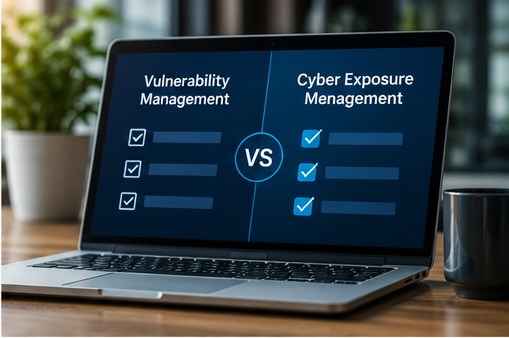
Vulnerability Management provides the assessment and remediation workflow. Cyber Exposure Management helps connect those findings to the external assets and paths that matter in practice.
If a patch cannot be deployed promptly, evaluate vendor-supported mitigations and restrictions appropriate to the system. Document their limitations and the planned fix. A temporary control should have an owner, a verification step and an expiry or review date.
Avoid treating an unverified exploit claim as proof of compromise. Equally, do not let the absence of a public exploit become the sole reason to defer a clearly consequential exposure.
Verify deployment and investigate the interval
A successful change ticket is not the same as evidence that every affected instance is fixed. Check the running version or vendor-recommended validation signal, include redundant nodes, and confirm that forgotten endpoints were not missed.
Where exploitation was plausible before remediation, investigate the exposure interval using available logs and relevant indicators. Patching closes the vulnerability; it does not independently remove access or persistence an attacker may already have established.
Threat Intelligence can help connect observed activity with affected technologies and guide investigation. The same pressure appears in agent-assisted abuse of exposed cloud secrets: reducing delay between discovery and a verified response matters across different entry points.
Practical takeaway: rehearse the decision path
Select a critical internet-facing service and work through a realistic advisory exercise. Confirm the owner, inventory accuracy, external reachability, emergency approval path, fallback controls and method for verifying remediation.
Measure the time needed to make a defensible decision and complete the action. Improve the handoffs that consume that time. Faster exploitation does not make prioritization obsolete; it makes reliable visibility, current context and practiced execution more valuable.